
Oranges and Lemons, say the Bells of St Clement’s
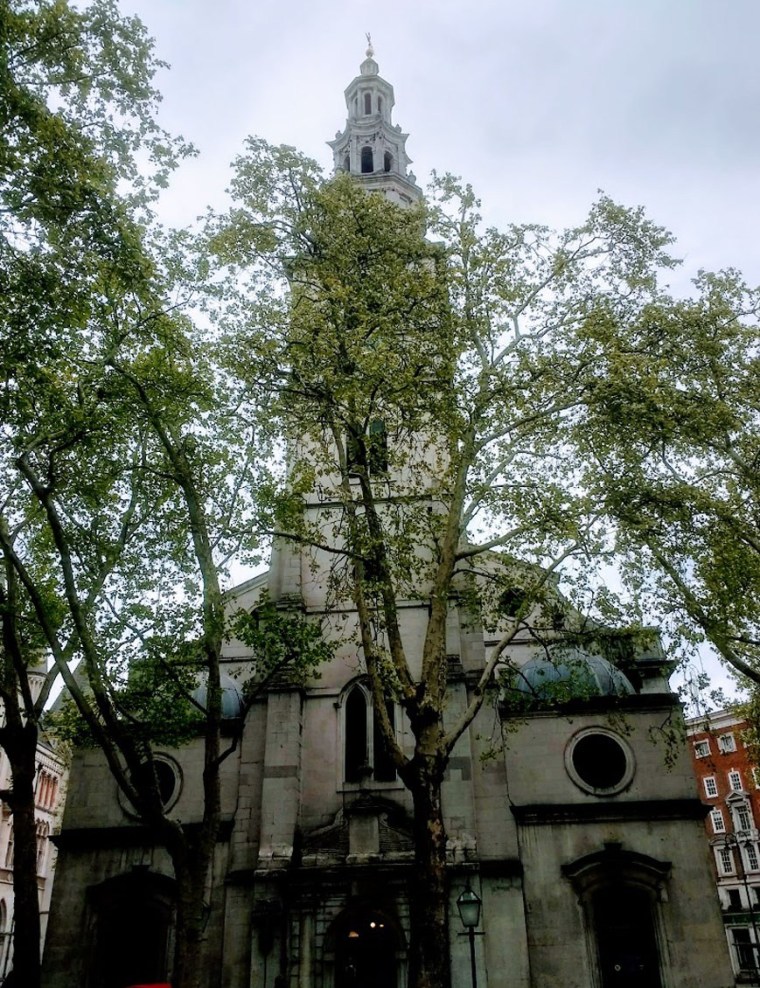
I could hear the bells of St Clement Danes, from two streets away, as I rushed across town towards it. One of two London churches that claim to be the St Clement’s mentioned in the nursery rhyme, this one is on the Strand, not far from the Royal Courts of Justice. As I turned the corner into the famous street, I was almost overwhelmed by the full volume of the bells’ glorious pealing. Was it a special occasion? It was for those taking part: the Ladies’ Guild of Change Ringers, including my old school friend, Chris.
She had travelled from Lancashire, to join the ringing of four ‘quarter peals’ on these finely tuned bells. As the final quarter peal came to an end, I dashed up the narrow spiral steps of the bell-tower, forgetting my fear of heights. Part way up, feeling dizzy, I held on to the adjacent stone walls and kept climbing.
Up there, was a room with commemorative plaques all around the walls, long loops of rope hanging down round a central space. I looked up to see … a high ceiling with holes where the ropes passed through. I was disappointed. I had expected to see bells. But of course that would have been deafening for the bell ringers. Chris, who is of quite small build, showed me how she stood to pull the ropes with both hands held aloft. I imagined the gigantic bells in the tower above that ceiling. Does she ever get arm-ache? “Not really” Chris explained, “because once you are ringing, the momentum of the bell swinging carries it round.”
Listening to the constantly changing sequence of notes, (known as change ringing) I had tried to work out the pattern but couldn’t detect any semblance of order. When I asked Chris how she knows when to ring, she showed me on her phone: pages and pages of row after row of numbers. It was like the book of logarithms we used to have at school.
“Each bell has a number. You don’t have to remember all the numbers though, you just have to memorise where your number comes in the sequence.”
Chris went on to explain that the bells were rung in a different sequence every time – for a full peal that’s until you have rung every possible order. It works out at five thousand and forty for a full peal. No wonder it takes so long to ring … several hours! The quarter peal has a quarter of that: one thousand two hundred and sixty different sequences.
“We have a conductor to help us if needed but it’s really your responsibility to keep yourself right. If anyone does ring out of sequence, that’s not a proper peal. So we all help each other.”
I had noticed on one of the plaques, that the bells of St Clement Danes had been damaged in the Blitz and recast in the Whitechapel Bell foundry in 1955. This foundry that had cast Big Ben and had been manufacturing bells since 1570, is now in danger of being made into a hotel. Had she signed the petition? Of course she had.
I asked Chris about Oranges and Lemons. I had been listening out for it. Did they ring it? Had I missed it?
“No, there’s a different set of bells, called a carillon, that rings that. It’s rung at six o’clock by an automated system.”
I went back at six and was delighted to hear the familiar melody sounding above the riot of rush hour traffic, a clip clopping horse-drawn cab, a helicopter overhead, motor bikes roaring, car horns blaring and a bit of shouting in the street!


 Liv's Music World