
Breaking the Silence: Afghan Youth Orchestra UK Tour

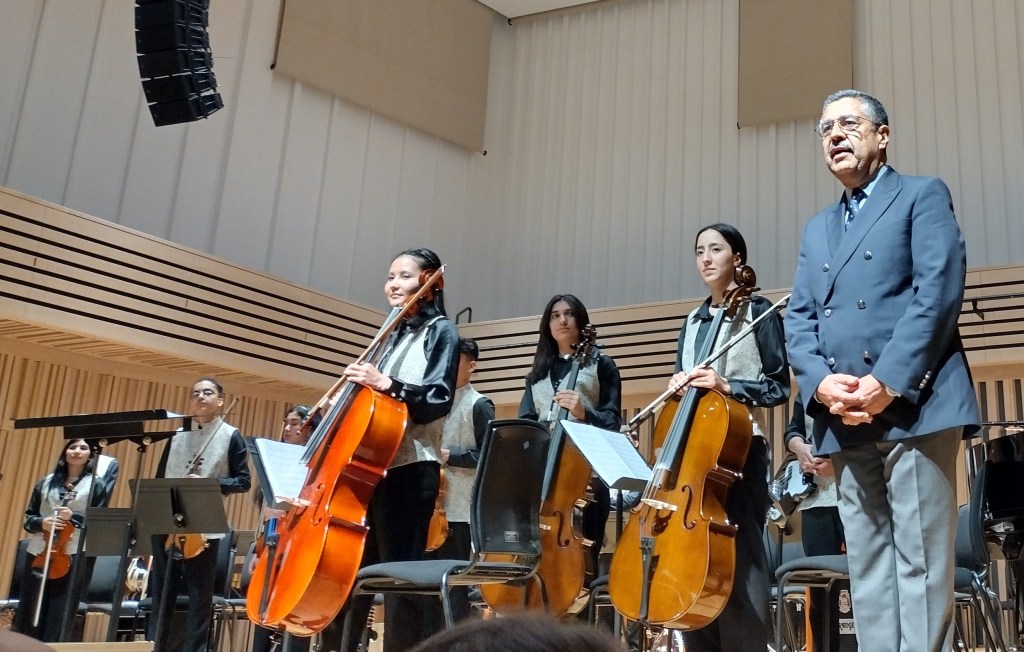
“What is happening in Afghanistan is cultural genocide and gender apartheid.” Ahmad Sarmast, Founder and Director of Afghanistan National Institute of Music called it out in a powerful speech at the concert given by the Afghan Youth Orchestra at Stoller Hall, Chetham’s School of Music in Manchester, on Monday 11th March 2024.

These talented and dedicated young people have, for two years, been rebuilding their lives in Portugal where they have been given hope for the future of their education and specialist musical studies. Of the orchestra’s 47 players, more than half that number are girls, whose human rights would have been curtailed had they stayed in Afghanistan.

Their concert opened with two small ensembles. First, two sitarists and a tabla player played Rag Yaman with great skill and musicality. Then, four young rubab players delighted us with the sound of Afghanistan’s national instrument, accompanied superbly by the tabla player.

Then the full orchestra performed a programme of traditional Afghan music plus Brahms’ Hungarian Dance no 5. Each piece was skillfully orchestrated for this unusual ensemble that integrated rubab, sitar and tabla with western instruments. There were beautiful moments where the melody heard on the rubabs was echoed in the cello section, or taken up by the violins. We heard some exquisite solos, within the texture, from some of the more advanced musicians. And I was particularly impressed by the orchestra’s mastery of rhythm and their superb ensemble playing under the baton of conductor, Tiago Moreira Da Silva.

Most pieces were upbeat and concluded with a flourish but there was one that had a different style. It began with dramatic discords in the bass and piano, before the melodic themes were introduced, including some virtuoso playing in brass and woodwind. Towards the end of the piece the musicians began to sing, quite softly. I found it emotional to hear their voices, so nearly silenced. The piece ended poignantly and quietly. For me, it was a moment of reflection on the reality of life for these musicians, amongst the evident joy of their music-making.

Then, the programme reverted to lively pieces, including one where we were encouraged to clap along. There followed a rapturous reception for these wonderful, brave musicians, who responded with an encore … Hey Jude!

After a standing ovation, Sarmast spoke again to remind us that although Afghanistan had fallen off the news agenda, the crisis in his country continues. He explained that this is one of several worldwide concert tours aimed at bringing attention to their plight. He asked us to do what we can to highlight the issue. He pointed out that within five years, music could be forgotten in Afghanistan. People are not allowed to listen to music, play music, make a living from music. The situation is not peaceful. As one of these young musicians said in a recent Channel 4 interview, “being human in Afghanistan is a crime, especially for a woman”. Channel 4 News, 09/03/24
Shamefully the UK does seem to have forgotten. We have a government which almost put a stop to this UK tour by denying visas, until public pressure and social media caused the Home Office to reverse its decision.

Human rights, women’s rights, the right to listen to and play music freely wherever you are – I can’t imagine not having these rights.

Next time I switch some music on, I will think about my less fortunate fellow humans, living without the freedom to do such a simple thing.

_______________________________________________

Find out more here: Afghanistan National Institute of Music

North Indian Classical Music: for Sarod and Tabla

Listen with Liv! This is where I share what I have been listening to recently.

I feel very fortunate when I am able to go to live performances of Indian classical music, here in the UK. Such a privilege then, to hear sarod virtuoso Debasmita Bhattacharya performing with tabla maestro Shahbaz Hussain at St Mary’s Cathedral in Edinburgh, recently. Performing without amplification, the sounds of the sarod and tabla sang clearly in the resonant acoustic of this magnificent stone building.

From Debasmita’s exquisite opening solos to Shahbaz’s melodic and virtuoso tabla playing, the pair complemented one another with their superb musical skills, synchronicity and balanced interplay.

Here’s a clip of Debasmita playing a slow improvised introduction (alap) which gradually introduces the melodic shape and mood of the rag. Then, a more rhythmic section (jor) increasing in speed and virtuosity. The rag here is Bhimpalasi – a pentatonic rag for early afternoon.

Film of Debasmita Bhattacharya performing with Shahbaz Hussain is also available by subscribing to Darbar You Tube channel.

https://www.darbar.org/#

https://debasmitasarode.com

https://www.shahbazhussaintabla.com

If you are in London this month, the Darbar Festival of Indian Classical Arts is on from 22 – 29 October 2023 at the Barbican – an immersive and exciting event if you are interested in Indian classical music and culture.

https://www.darbar.org/festival/darbar-festival-2023

Edinburgh Fringe 2023: Soloists of the Scottish Chamber Orchestra series – Su-a Lee with Hamish Napier

An absolute gem in this year’s Fringe, this concert showed what fun can be had through creativity and musical collaboration, particularly when the musicians have such admiration and respect for one another as these two: Su a Lee, Assistant-Principal Cellist with the Scottish Chamber Orchestra, well known for her versatility in many genres of music and Hamish Napier, whom she introduced as one of Scotland’s most talented folk musicians and a composer, who also happens to be her husband.

On Saturday afternoon in a packed Northesk Parish Church in Musselburgh, Su-a and Hamish brought us a melding of different styles of music. Scottish folk songs and Hamish’s original compositions were interspersed with the six movements of Bach’s first cello suite.

Su-a Lee opened the concert with a piece for solo cello – an arrangement of Burns’ Ae Fond Kiss by the late Kevin McCrae, her fondly remembered friend and colleague from the SCO, who had introduced Su-a to Scottish traditional music, many years ago. After beginning simply, Kevin’s arrangement weaves the melody into an undulating line, reminiscent of the Prelude from Bach’s first suite. Su-a followed this with that prelude, playing with a wonderful lightness of touch and an airiness in the phrasing.

Hamish then joined the stage at the piano to play two strathspeys with Su-a, including one of his own. The strathspey is a traditional dance style originating from Hamish’s beloved Speyside, where he spent his childhood and now lives. He explained how the landscape of this area inspires many of his compositions. Hamish too, is a versatile musician: singer, pianist and flautist. I was struck by his eloquent voice in Burns’ Silver Tassie and his flute playing in another of his compositions, a hornpipe called The Wee Plank which came with a story involving a stash of cash hidden under a floorboard!

As the programme unfolded, we were drawn into their world as they described their home in the Cairngorms National Park where they lived during lockdown. We heard about the Scots pine under which Su-a played her cello and made several recordings. She chose a piece which Beatrice Harrison famously played outdoors accompanied by nightingales for BBC broadcasts in the 1920s: Songs My Mother Taught Me by Dvorák. The concert had been introduced as ‘impossible to categorise’ but it was still surprising to hear this romantic piece, deliciously played by the duo.

When it came to the Bach Sarabande, Su-a played unaffectedly and finished with a little run at the end that led into to Hamish’s compositions inspired by Scotland’s native trees. And then, as Su-a played the Minuets, Hamish joined in at the piano subtly at first before introducing some lush chords that would have made Bach smile. The final Bach movement for me was perfection, as Hamish seamlessly switched instruments so that flute and cello danced the Gigue together. Genius!

The audience loved it and were treated to two encores with Su-a playing … the saw (!) accompanied by Hamish at the piano. The first was a tribute to their mothers, who were in the audience, and then a piece they had played outside every week during lockdown: Somewhere over the Rainbow. This was astonishing – that a saw can produce such a musical sound – well it can when Su-a is playing it.

The whole programme was crafted so well and played so beautifully, the rapport between them shared so generously that you couldn’t help but come away smiling almost as much as Su-a!