I am going to explore some particular locations and their relationship with music. It might be an emotional response that connects the two or just the fact of music coming from a certain place that creates an association. I begin with my second home: Lancashire and the South Pennines.
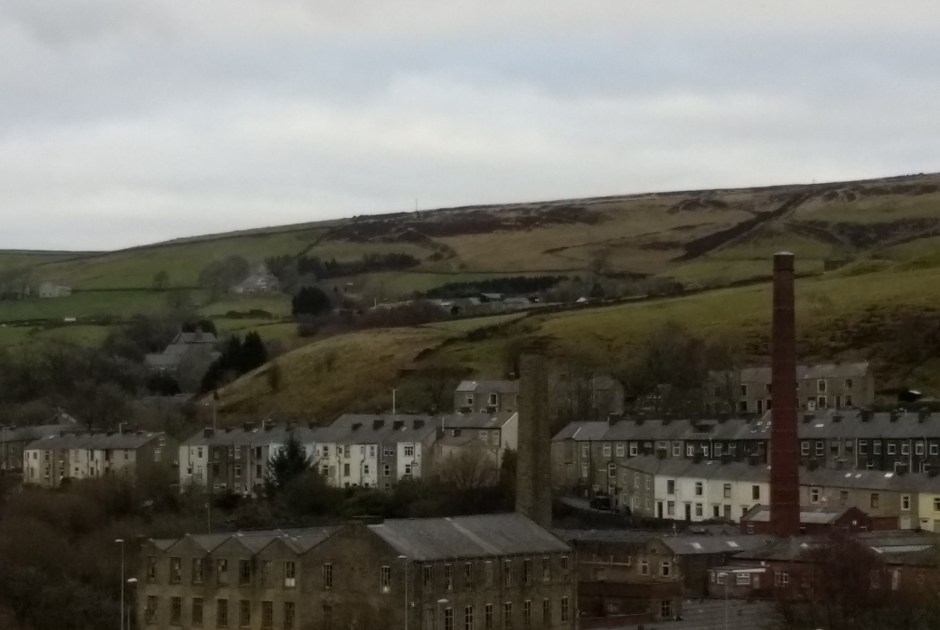
When I was a teenager we moved from suburban North Manchester to a former mill-town in semi-rural Lancashire. The cotton industry was in decline but many of the old mills and chimneys still dotted the landscape and were being used for various business purposes. My sister, friends and I would walk up over the hill to explore, wandering across fields and climbing over stone walls. We found a disused quarry that was like a cavern with huge slabs of sandstone rocks all around. It was like another planet. Our favourite place though, was a mill pond where we would sit on summer days, looking for tadpoles or minnows and watching the swallows swooping and diving above the water. We could hear the noises of machinery from inside the mill but we didn’t see anyone come in or out. We weren’t sure whether we were allowed to be there but we claimed it as ours, as we roamed about, curious at this new landscape.

At that time, I also had a curiosity about classical music and we must have been listening to the music of the English composer, Delius, which, to us, had a dreamy quality that seemed to describe our carefree wanderings. We came to associate his music with this landscape and our mill lodge, as it was known locally, became for us, the Delian pond!
In fact, Delius had been born on the other side of the Pennines, over the moors, in Bradford, Yorkshire and spent his youth avoiding pressure from his father to follow him into his woollen business. His roots were part German, part Dutch. He lived in Florida, and Germany before settling in France, only returning to live in England for the duration of WW1. His music, in our minds, evoked our own romantic view of the English countryside and long summer days.
The music that perhaps is more appropriate for this landscape is the music of Lancashire Clog Dancers. From the beginning of the industrial revolution, Lancashire mill workers had worn clogs as everyday footwear. They were cheap, hardwearing and protected their feet from the wet and cold floors. The clogs had wooden soles, with iron shoes and leather uppers. The clacking sound they made on a stone flagged floor was perfect for tapping rhythms and mill-workers soon discovered their potential as a form of entertainment. Clog dancing became popular amongst workers and a few found a way out of mill-working by becoming professional dancers, performing in the popular music halls. Dance steps were invented that imitated the rhythms, movements and clattering noise of the machinery.

The tradition gradually lost popularity and was in danger of dying out by the 1950s when a few enthusiasts and collectors of folk traditions began reviving interest in Lancashire clog dancing. They recorded the steps which continue to be danced to this day in clubs and societies which aim to promote the tradition.
The Oakenhoof Cloggers and the Black Nan Band, are one such organisation, which offers free weekly classes in clog dancing and music respectively. They are based in Littleborough, are open to all ages and perform regularly, including at the annual Rushbearing Festival.
Another clog dancing group, known as the Lancashire Wallopers, formed in 1981, in Leyland, perform at Festivals throughout the country and run an annual clog-dancing weekend aimed at all-levels from beginners to advanced, for dancers and musicians. The original members were taught by a well-known dancer and music-hall entertainer by the name of Samuel John Sherry (1912 – 2001). Sam, as he was known, had a popular following during the 1930s, along with the touring group he and his brothers formed: The Five Sherry Brothers. Sam started teaching (and performing again) in the 70s and 80s and as interest grew, he instigated the annual Lancashire and Cheshire Clog Dancing Competitions.
Outside of Lancashire, the English Folk Dance and Song Society based at Cecil Sharp House in London have a group: Camden Clog who run classes and workshops based on the East Lancashire style preserved for future generations by Pat Tracey (1927 – 2008). Pat was a talented clog dancer from the Lancashire town of Nelson, who was living in London at the time that the English Folk Dance Society (as it was then) were looking for teachers. She was responsible for teaching many of the dances that are still danced, which she had learnt from her parents whose knowledge had been passed on through the generations, dating back to the mid 19th century.
The music for Lancashire clog dancing seems to be based on hornpipes and jigs which suit the clickety, clackety dance steps. Some Irish and Scottish tunes also seem to have been amalgamated into the Lancashire clog dance repertoire. Popular instruments appear to be fiddle and squeeze-box.
I am going to give this a go and find out more about it but in the meantime, here’s a clip of the Lancashire Wallopers making it look so easy!
To learn more about Lancashire Clog Dancing or to join in:
was responsible for teaching many of the dances that are still danced today: heel toe, hornpipe and waltzes which she had learned from her parents whose knowledge had been passed on through the generations, dating back to 1800s.was responsible for teaching many of the dances that are still danced today: heel toe, hornpipe and waltzes which she had learned from her parents whose knowledge had been passed on through the generations, dating back to 1800s.was responsible for teaching many of the dances that are still danced today: heel toe, hornpipe and waltzes which she had learned from her parents whose knowledge had been passed on through the generations, dating back to 1800s.
was responsible for teaching many of the dances that are still danced today: heel toe, hornpipe and waltzes which she had learned from her parents whose knowledge had been passed on through the generations, dating back to 1800s.

 Liv's Music World